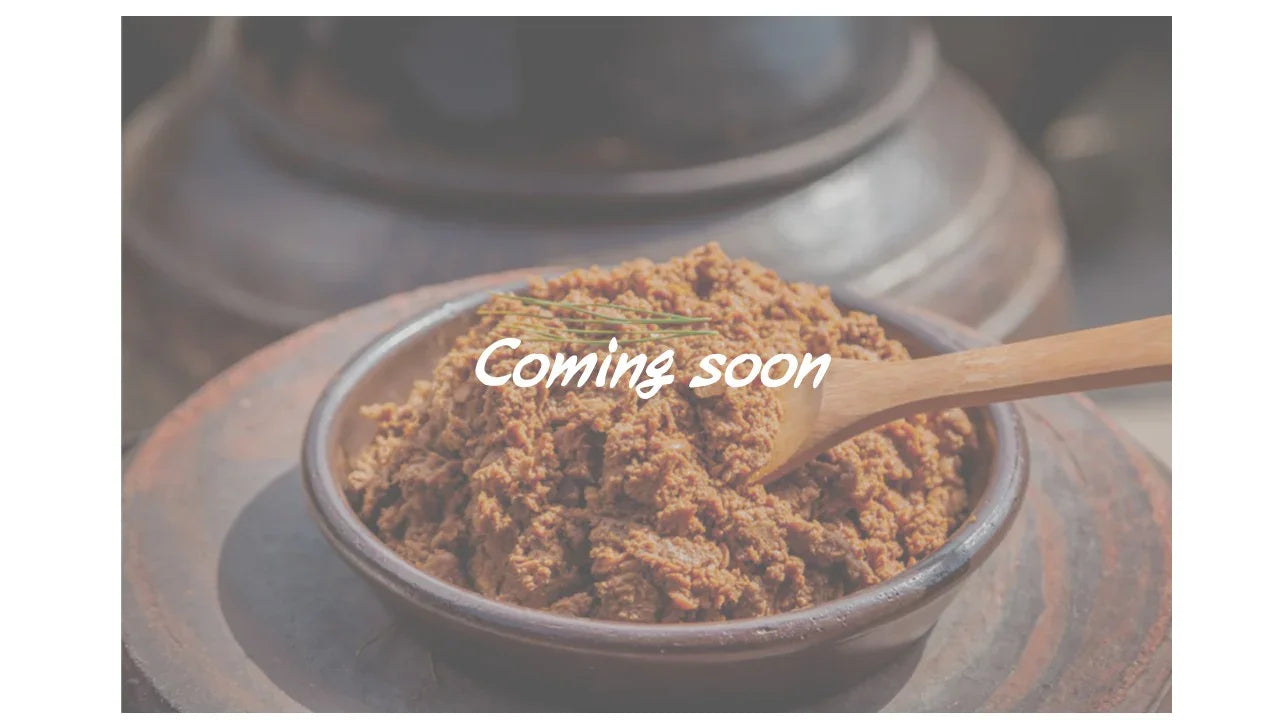
다농식품 조선 된장
Traditional doenjang (soybean paste), fermented and aged on the family yards in Chojeong, Cheongju, housing over a 1,000 jangdok, carrying on 3 generations of family history.
Doenjang as it should be, made the way Korean households have made it for generations, following the rhythm of the seasons rather than a production schedule.
Meju (fermented soybean blocks) is dried and fermented slowly over roughly two months, then aged in brine alongside ganjang before the two are separated.
The doenjang continues to deepen for a minimum of two years in traditional onggi, through the shifting temperature and humidity of each season.
The slow aging softens the saltiness and builds a deep, balanced flavour, that only time and care can foster.
Sought after in Korea by those who appreciate tradition, quality, natural ingredients, and can be found on the shelves of high quality grocers and department stores.
In glass jars of 450g.
Ingredients
Made with 100% Korean ingredients:
Soybeans 55%, purified water 33%, sea salt 12%.
Made with pesticide-free Korean soybeans, sun-dried sea salt from Imja-do, Sinan, and water drawn from Chojeong - a region historically known for its water.
No added sugar, artificial preservatives or additives.
Made purely as was traditionally.
Contains no added alcohol.
Halal.
Storage instructions
Unlike industrially made doenjang which is pasteurised, traditionally made doenjang is not pasteurised, and is better kept refrigerated.
Artisan's story (link to be updated)
Cho Jung-sook married into the Chogye Byeon clan and absorbed the jang making methods beside her mother-in-law, learning to feel the condition of beans, the smell of fermenting meju, the state of the brine.
Learning jang making meant inheriting not just technique but the household's whole way of life and spirit, the jangdok, meju, the smell of doenjang "simply part of everyday life, not anything special".
"The flavour of jang does not stem from mere measurements of ingredients and products. To learn the art takes feeling and recognising the scent of jang" - Cho Jung-sook
Made in Chojeong, Cheongju, a region historically known for its water, using pesticide-free Korean soybeans, and sun-dried sea salt from Imja-do.
Over 1,000 onggi now stand on their terrace, each holding jang that ages through the seasons.
And now, we warmly share the heritage and experience with you.